How Long Should I Study for the CCSE?
By the CCSE English editorial team · Last verified: August 29, 2026
If you are learning the question bank rather than merely checking what you already know, allow about 12 weeks. Ten focused minutes most days give difficult questions time to return, be retrieved, and become durable.
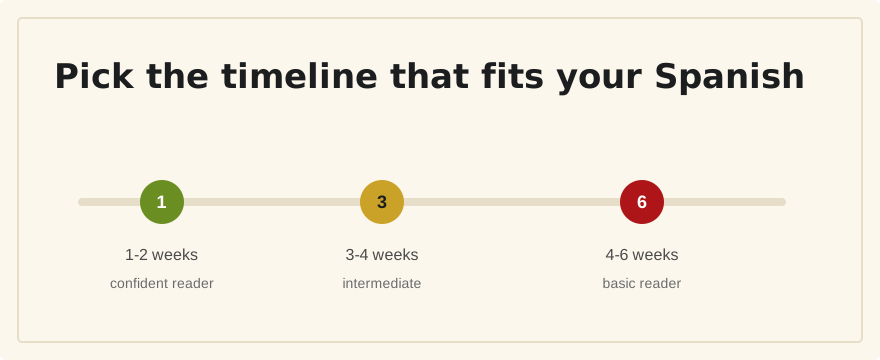
Start With the Official Format
The CCSE is 25 questions in 45 minutes, and you need 15 correct answers to pass. Begin with the official 2026 manual, PDF, and sample-question guide, which links to the free Instituto Cervantes materials. Start with a Spanish-only baseline, but do not let one passing result stand in for retention: mock scores show exam performance, while spaced review shows what remains available over time.
The official CCSE exam itself is in Spanish, so your final practice should use the Spanish question wording even if you learn concepts through English explanations first.
The Recommended 12-Week Path
- Weeks 1–4 · Understand: take a baseline, establish the ten-minute habit, and use English explanations when the Spanish obscures the idea.
- Weeks 5–8 · Build: complete due reviews before new material and steadily work through the full bank without forcing a daily question quota.
- Weeks 9–11 · Retain: let correct questions move to longer review intervals, focus on weak chapters, and take one Spanish-only mock each week.
- Week 12 · Rehearse: keep up with due reviews, take two well-spaced mocks early in the week, and use light targeted review before exam day.
This is a model, not a deadline or guarantee. Wrong answers, missed days, reading pace, and Spanish familiarity all affect the timeline. Use the printable retention-first CCSE planner to turn these stages into checkboxes and keep exam-day documents alongside your study plan.
Adjust the Plan From Your Baseline
- 0–14 out of 25: use the full 12-week plan, or longer if Spanish reading is also a barrier.
- 15–19 out of 25: plan roughly 8–12 weeks; you are near the line, but one score is fragile.
- 20–25 out of 25: you may need a shorter confirmation period, but still test the full bank and repeat several Spanish-only mocks.
A high baseline means you may already know much of the material. It does not show that concentrated study can create the same retention as spaced study.
Why Small Daily Sessions Work
Spacing and retrieval practice are well-established learning principles. Distributing study over time generally supports delayed retention better than massing the same opportunities together, and retrieving an answer from memory strengthens later recall more than simply rereading it. CCSE English applies those principles by bringing due questions—including material still in learning after a miss—back before introducing more new material.
The evidence supports the method, not a guaranteed CCSE result or one perfect schedule for every learner. The app's timings and Readiness Index are practical study tools rather than independently validated predictions.
If Your Exam Is Only One or Two Weeks Away
Treat the remaining time as triage, not mastery. Take a Spanish-only baseline, work on wrong and uncertain topics every day, and use two or three timed mocks to confirm performance. If you are not reliably above the pass line, consult the official booking and change rules rather than assuming a last-minute sweep through all 300 questions will stick.
When You Are Ready
A good readiness signal is consistently scoring above the pass mark with a margin. Because the official pass mark is 15 out of 25, many learners aim for 20 or more in practice before sitting the exam. Pair that signal with spaced recall: several good mocks tell you that you can perform, while longer review intervals show that the answers are not only fresh from yesterday's study.
Sources
- Instituto Cervantes: CCSE format and pass mark
- Instituto Cervantes: CCSE preparation materials
- Instituto Cervantes: CCSE 2026 exam dates and registration deadlines
- Cepeda et al.: distributed-practice meta-analysis
- Roediger and Karpicke: retrieval practice and delayed retention
- Lindsey et al.: personalized spaced review and long-term retention