Do I Need Spanish to Pass the CCSE?
By the CCSE English editorial team · Last verified: October 6, 2026
Yes. The official CCSE exam is written in Spanish. English can help you study, but it does not replace the Spanish you will see on exam day.
Is the CCSE Available in English?
No. The CCSE is only given in Spanish. On exam day you cannot rely on a translation either: the official CCSE exam guide says candidates may not bring any reference or writing material into the exam room, because the center provides the pencil and eraser you need. That rules out dictionaries, phrase lists, and printed glossaries.
The same guide is also clear that the CCSE is not a language test. Its aim is to check knowledge and understanding of Spain's constitutional and sociocultural concepts, not your Spanish. You never write or speak Spanish, every question has closed answer options, and Instituto Cervantes says it simplified the wording where it could for the people taking the exam.
What Spanish the Exam Uses
Instituto Cervantes says the CCSE questions use contemporary peninsular Spanish. The questions are short, and the official description says the texts are adapted so most grammar and vocabulary should be accessible to candidates. Still, you need to recognize words like derechos, deberes, Gobierno, Congreso, comunidad autónoma, and ayuntamiento.
CCSE Spanish Is Different From DELE Spanish
The CCSE is a knowledge test, not a general language exam. It does not test speaking, listening, or writing. DELE A2, by contrast, is a Spanish-language diploma with reading, listening, writing, and speaking parts. Many nationality applicants need both, but they measure different things.
What the Official Glossary Covers
Instituto Cervantes publishes a free CCSE glossary alongside the official manual. It lists about 230 key Spanish terms, each with a short translation into English, French, Portuguese, Arabic, Hebrew, and Turkish: for example, alcalde is “mayor” and aconfesional is “secular, non-denominational.”
It is a useful word list, but it is only a word list. It does not translate the 300 official questions or their answer options, it does not explain why an answer is correct, and you cannot use it during the exam. Our CCSE Spanish–English glossary builds on it with plain-English explanations and common translation traps for the terms that cause the most confusion.
How to Tell If Your Spanish Is Enough
You have 45 minutes for 25 questions, a little under two minutes each, so the practical test is whether you can recognize the civic vocabulary quickly. Before booking, check yourself against these signs:
- You can read a question and its answer options in Spanish and say what is being asked, without translating every word.
- Words like derechos, Cortes Generales, comunidad autónoma, and ayuntamiento no longer need a lookup.
- You notice small wording changes, such as negatives in true/false statements, on the first read.
- You finish a timed 25-question mock exam in Spanish with time to spare and consistently score above 20.
If you are not there yet, the gap is usually civic vocabulary, not grammar, and it closes with short daily practice. See how long to study for the CCSE for a realistic timeline.
Where English Helps
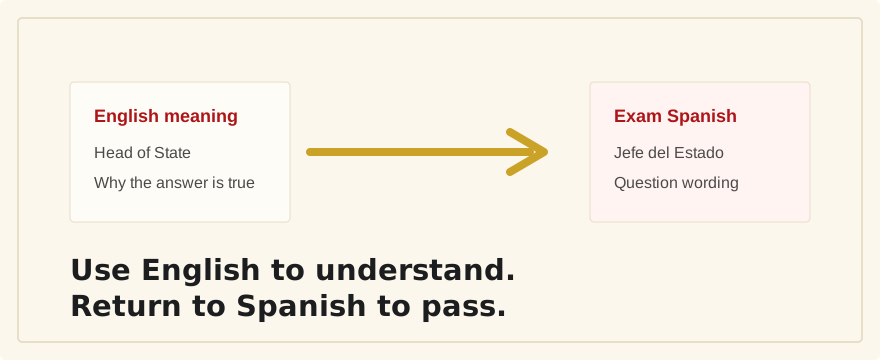
English is useful before the exam because it lets you understand why an answer is correct. If you only memorize Spanish sentences, a small wording change can throw you off. If you understand the idea in English and then connect it back to the Spanish, you are less dependent on pattern matching.
That is the role of CCSE English: Spanish and English side by side, with plain-English explanations. It is independent and not affiliated with Instituto Cervantes or the Spanish government.
Try the Spanish, then open English help
What do soberanía nacional and obliga mean in a question? Try two examples and see how an English explanation connects the wording to the idea.
Independent practice using the 2026 study pack. Try the full five-question sample.
What to Practice
- Read each Spanish question before looking at the English.
- Mark recurring civic vocabulary and learn it as vocabulary, not trivia; begin with the CCSE Spanish–English glossary.
- Practice true/false wording carefully; negatives and legal terms can be easy to miss.
- Take timed 25-question mock exams in Spanish once you are near your exam date.
Sources
- Instituto Cervantes: CCSE language, format, and duration (archived copy)
- Instituto Cervantes: CCSE preparation materials and glossary (archived copy)
- Instituto Cervantes: CCSE exam guide (purpose, exam-room rules) (archived copy)
- Instituto Cervantes: DELE A2 exam structure (archived copy)