Spanish Citizenship for Filipinos: Two-Year Route, CCSE and DELE
By the CCSE English editorial team · Last verified: October 21, 2026
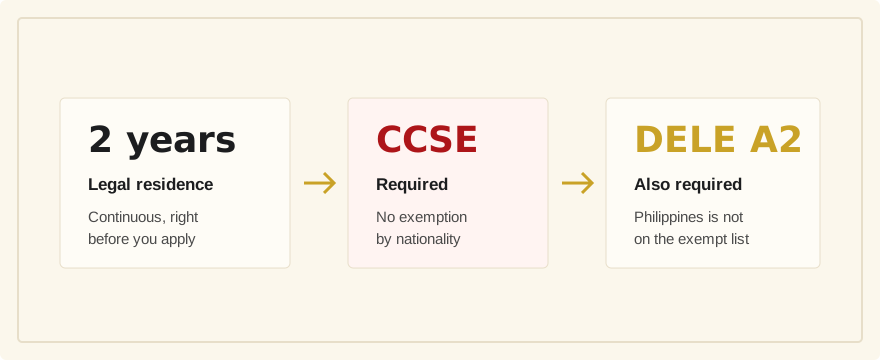
Filipino citizens can apply for Spanish nationality after two years of legal residence instead of ten. The shorter wait does not remove the exams: the CCSE is still required, and so is the DELE A2 in most cases.
Who Qualifies for the Two-Year Route
Article 22 of the Spanish Civil Code sets ten years of residence as the general rule. It reduces this to two years for nacionales de origen of Ibero-American countries, Andorra, the Philippines, Equatorial Guinea, and Portugal, and for Sephardic Jews.
Two details in the same article matter:
- “Nacionales de origen”: the law refers to nationals by origin. If you acquired Philippine citizenship later in life, confirm with an adviser whether the two-year route applies to you.
- Legal, continuous, immediately before: the two years must be legal residence, without breaks, and must end when you apply.
The same article also requires good civic conduct and a sufficient degree of integration into Spanish society. The CCSE and DELE are how most applicants prove that integration.
Do Filipinos Need the CCSE?
Yes. Royal Decree 1004/2015, article 6 requires nationality-by-residence applicants to pass the CCSE, and it does not exempt anyone by nationality. Some situations are handled differently, such as minors and applicants with disabilities, so check official guidance if one applies to you.
The CCSE is a 25-question exam in Spanish on Spain's Constitution, government, territorial organization, culture, history, and society. To pass, you need 15 correct answers. See What Is the CCSE Exam? for the format and CCSE registration, price and dates to book.
Do Filipinos Need the DELE A2?
In most cases, yes. This is where many online sources go wrong. Article 6.5 of the same decree exempts the nationals of 20 Spanish-speaking countries and territories from the DELE: Argentina, Bolivia, Chile, Colombia, Costa Rica, Cuba, the Dominican Republic, Ecuador, El Salvador, Equatorial Guinea, Guatemala, Honduras, Mexico, Nicaragua, Panama, Paraguay, Peru, Puerto Rico, Uruguay, and Venezuela. The Philippines is not on the list.
The confusion is understandable. The Philippines shares the two-year route and the dual-nationality rules with Ibero-American countries, and Spanish was once an official language there. The DELE exemption is a separate list, and it follows the language of the country today.
You can skip the DELE exam if you already hold a DELE diploma at A2 or higher, or another official Spanish-language certificate at A2 or above. See CCSE vs DELE for how the two exams differ.
Do You Have to Give Up Philippine Citizenship?
Not for Spain. Article 23 of the Civil Code normally requires new Spanish nationals to renounce their previous nationality, but it exempts the countries listed in article 24, which include the Philippines.
Philippine law is a separate question. Under Republic Act 9225, natural-born Filipinos who become citizens of another country can keep or reacquire Philippine citizenship by taking an oath of allegiance. The Philippine Embassy in Madrid handles this. Ask the embassy before your Spanish nationality is granted, so you know what it needs.
A Practical Order of Steps
- Confirm your legal residence dates and that the two-year route applies to you.
- Book the DELE A2, and start preparing early: it tests reading, listening, writing, and speaking.
- Book the CCSE. Results take about 20 days, so leave time before you plan to apply.
- Gather your documents and apply through the Ministry of Justice.
- If you want to keep Philippine citizenship, arrange the RA 9225 oath with the embassy.
The timeline for Spanish citizenship covers these steps in more detail.
Looking for a CCSE Reviewer?
The best CCSE reviewer is free: Instituto Cervantes publishes the official manual with the current bank of 300 questions the exam draws from. Our guide to the CCSE 2026 manual, PDF and sample questions explains where to download it and how to use it.
The manual and the exam are in Spanish. If you are studying for the DELE A2 at the same time, the CCSE questions double as reading practice. If you want English help while you learn the material, a bilingual study tool can bridge the gap. Keep practising the Spanish wording you will see on exam day.